
Re-Splitting Aces (RSA): The Rarest Friendly Rule at the Table
If Doubling After Splitting is an underappreciated rule, Re-Splitting Aces - commonly abbreviated RSA - is close to an endangered species. It's one of the rarest player-favorable rules left in modern blackjack, offered at only a small minority of tables, and most players never encounter it often enough to fully understand its value or how to use it. This article walks through what RSA actually means, why it's so uncommon, how much it's genuinely worth, and what to know about it if you're lucky enough to find a table that offers it.

If Doubling After Splitting is an underappreciated rule, Re-Splitting Aces - commonly abbreviated RSA - is close to an endangered species. It's one of the rarest player-favorable rules left in modern blackjack, offered at only a small minority of tables, and most players never encounter it often enough to fully understand its value or how to use it. This article walks through what RSA actually means, why it's so uncommon, how much it's genuinely worth, and what to know about it if you're lucky enough to find a table that offers it.
| Rule point | Typical split-ace rule | When RSA is offered | Why it matters |
|---|---|---|---|
| Another ace appears | No further split is normally allowed. | You may split again, subject to the table's cap. | The source says this can create a third or even fourth hand. |
| Cards per split-ace hand | Usually exactly one additional card. | Usually still exactly one card after each split. | RSA governs re-splitting, not automatically hitting or doubling split aces. |
| Approximate house-edge effect | No RSA benefit. | About 0.03% to 0.08% lower, depending on the cap and the rest of the rules. | The benefit is real but modest because the situation is uncommon. |
| Table-selection role | Common baseline. | A player-friendly bonus or tiebreaker. | The source says payout, soft 17, and DAS deserve more weight. |
What Re-Splitting Aces Means
To understand RSA, start with the baseline rule that governs split aces almost everywhere. When a player is dealt a pair of Aces and chooses to split them, the vast majority of tables apply two restrictions simultaneously: each resulting hand receives exactly one additional card, and no further action is allowed on that hand - no hitting, no doubling, and critically, no further splitting even if the card dealt happens to be another Ace. If you split A-A and are dealt another Ace on one of the resulting hands, standard rules force you to simply stand there with a two-card total that would otherwise be a magnet for a split, because a hand of Ace-Ace (worth soft 12) is genuinely one of the strongest hands in the game to keep splitting under normal circumstances.
RSA removes that restriction. If you split your Aces and one of the resulting hands receives another Ace, RSA allows you to split again, creating a third hand - and, at tables with especially generous RSA rules, this process can repeat multiple times, allowing four total hands from an original pair of Aces if the cards cooperate. Each split requires an additional matching wager, exactly like the original split, so RSA can meaningfully increase the total amount in action on a single deal if the cards run that way.
Why RSA Is So Rare
RSA is uncommon for a straightforward reason: split aces are already one of the strongest possible outcomes for the player, and casinos are naturally cautious about rules that amplify an already-favorable situation. A starting hand of two Aces is worth soft 12, one of the weakest two-card totals in the game if played as a single hand, but split into two separate hands, each Ace becomes the foundation of a hand that has roughly a one-in-three chance of immediately becoming a two-card 21 on the very next card (any ten-value card completes it, and ten-value cards make up close to a third of a full, unmodified deck). Two Aces split into two hands is already a significant swing in the player's favor compared to keeping them together; allowing a third or fourth hand off subsequent Aces compounds that advantage further.
Because of this, most casinos apply the tightest possible restriction to split aces as a matter of course - one card each, no further splitting, no doubling - treating the ace-split rule as one of the few areas of the game where they're unwilling to extend additional player-friendly flexibility, even at tables that are otherwise fairly generous on rules like DAS or surrender. RSA tends to show up primarily at single-deck and double-deck games in competitive markets, at some higher-limit tables where casinos are comfortable with more variance in exchange for larger average wagers, and in some online and live-dealer formats where operators use RSA as a specific marketing differentiator.

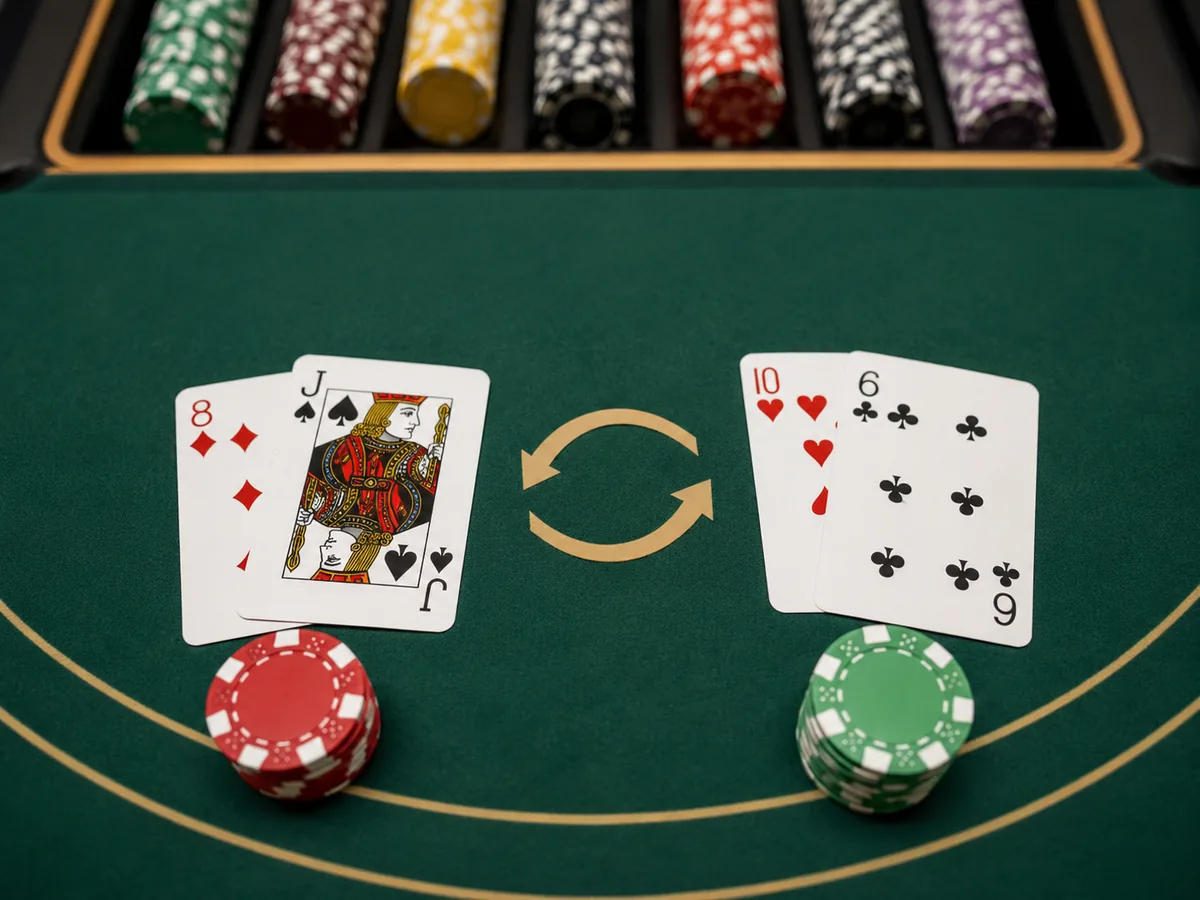
The Mathematical Value of RSA
Key number from the source: RSA is estimated to reduce the house edge by roughly 0.03% to 0.08% versus no RSA, depending on the permitted re-splits and the rest of the rules.
RSA's impact on the house edge, while real, is smaller than many players assume - largely because the scenario it applies to (splitting aces, and then drawing yet another ace on a resulting hand) is relatively rare in absolute terms. As a general estimate, allowing unlimited or near-unlimited re-splitting of aces reduces the house edge by roughly 0.03% to 0.08% compared to a table that disallows it entirely, with the precise figure depending on how many total re-splits are permitted and the rest of the rule package in play.
This is a smaller effect than DAS and considerably smaller than the blackjack payout ratio, but it's not nothing, and it compounds with every other player-favorable rule at a truly generous table. It's also worth noting that RSA's value is somewhat asymmetric: it doesn't hurt you to have the option even if you rarely use it, since the rule only ever activates in your favor (you're never forced to re-split; you're simply given the choice when the situation arises).
How Often RSA Actually Comes Into Play
It's worth being realistic about how frequently this rule matters in practice. In a standard shoe, roughly 1 in 13 cards is an Ace. After splitting your first pair of Aces, the probability that either resulting hand draws a third Ace on its very next card is relatively low, and the probability of a fourth Ace appearing to trigger a third re-split is lower still. Over the course of an average session, most players who have access to RSA will use it only a small handful of times, if at all - which is exactly why its impact on the overall house edge, while genuine, is modest compared to rules that come into play far more frequently, like the blackjack payout ratio or the dealer's soft-17 rule, both of which affect essentially every hand dealt.
This doesn't mean RSA is unimportant. It means its value is best understood as a "when it rains, it pours" rule - largely irrelevant on the vast majority of hands, but a meaningful boost to your equity on the rare occasions it does apply, since each re-split of aces gives you another near-one-in-three shot at an immediate strong hand.
Strategy Considerations When RSA Is Available
Basic strategy is generally simple on this point: at a table offering RSA, if you split your Aces and draw another Ace on a resulting hand, the correct play is almost always to split again, exactly as you would have split the original pair. The same logic that makes splitting Aces attractive in the first place - turning a weak combined total into two (or more) hands each anchored by a strong solo card - applies identically to every subsequent Ace you draw.
There are a small number of edge cases worth knowing. Some tables that offer RSA cap the total number of hands you can create from split aces (commonly at three or four hands total), so it's worth clarifying the cap with the dealer if you find yourself in an unusually lucky sequence. Also, because each new split requires committing an equivalent additional wager, players on a tighter bankroll should be mentally prepared for the possibility of needing to cover two or three extra bets in a single deal if the aces keep coming - it's an uncommon situation, but one worth having chips ready for rather than being caught off guard.
RSA and the One-Card-Per-Hand Restriction
It's important to distinguish RSA from a separate, related rule: whether split aces are limited to a single additional card each. The overwhelming majority of tables - RSA or not - still apply the one-card rule to any individual ace-based hand once it's been split. In other words, RSA governs whether you can create additional hands from subsequent aces; it does not typically also grant you the ability to hit or double on those new hands beyond their single mandatory card, unless the table explicitly advertises additional liberalized rules for aces (which is rarer still and typically found only in very specific high-roller or specialty games).
Because these two rules are often confused, it's worth asking the dealer both questions separately if you want full clarity: "Can I re-split aces?" and "Do split aces only get one card?" The answers are usually yes and yes, respectively, but it's the kind of detail worth confirming rather than assuming, especially if you're playing at an unfamiliar casino or an online room you haven't used before.
Where to Find RSA
RSA tends to cluster in a few predictable places:
- Single-deck and double-deck pitch games, particularly in competitive markets like downtown Las Vegas, where operators lean on a combination of favorable rules to differentiate themselves from Strip resorts running larger shoe games.
- Higher-limit tables at major casinos, where the house is more willing to extend generous rules in exchange for larger average bets and is less concerned about the marginal additional variance.
- Select online and live-dealer blackjack tables, where some operators specifically advertise RSA (along with other liberal splitting and doubling rules) as a competitive differentiator that's easy for players to compare across sites.
- Specialty or "high roller" blackjack variants, which sometimes bundle RSA together with other liberalized rules like doubling on split aces or unlimited re-splits on any pair, not just aces.
As with DAS, RSA is rarely printed prominently on standard felt signage, so asking the dealer directly remains the most reliable way to confirm its availability before you sit down.
Practical Takeaways
Re-Splitting Aces is a genuinely player-favorable rule, but its rarity in the market and its relatively low frequency of activation mean it shouldn't be weighted as heavily in your table-selection decision as rules like the blackjack payout ratio, the soft-17 rule, or even DAS. Think of it as a pleasant bonus rather than a headline feature: if you find a table offering RSA alongside an otherwise strong rule package (3:2 payouts, S17, DAS, reasonable doubling restrictions), treat it as a genuine point in that table's favor. But don't go out of your way to seek out a weaker overall rule set purely because it happens to include RSA - the modest edge reduction it provides is easily wiped out by a worse payout ratio or a worse soft-17 rule elsewhere at the same table. Used as a tiebreaker between otherwise comparable tables, though, RSA is a real and legitimate reason to choose one seat over another.