
Single Deck Blackjack: The Advantages, the Catch, and How to Spot the Difference
Single deck blackjack has a certain mystique to it. It's the format most closely associated with the game's earliest casino history, it's frequently marketed with language suggesting a better deal for the player, and it's genuinely true that, all else being equal, fewer decks mathematically favor the player. But "all else being equal" is doing a lot of work in that sentence, and single deck games are one of the clearest examples in all of blackjack of a rule that can't be evaluated in isolation. This article explains why deck count matters, how much it's actually worth, and why the specific single-deck table you're looking at might be a great deal or a trap dressed up in attractive marketing.

Single deck blackjack has a certain mystique to it. It's the format most closely associated with the game's earliest casino history, it's frequently marketed with language suggesting a better deal for the player, and it's genuinely true that, all else being equal, fewer decks mathematically favor the player. But "all else being equal" is doing a lot of work in that sentence, and single deck games are one of the clearest examples in all of blackjack of a rule that can't be evaluated in isolation. This article explains why deck count matters, how much it's actually worth, and why the specific single-deck table you're looking at might be a great deal or a trap dressed up in attractive marketing.
| Feature | Single deck | Six/eight-deck shoe | What the source says to watch |
|---|---|---|---|
| Deck-count effect | Player-favorable when other rules are identical. | Less favorable from deck count alone. | The source estimates roughly 0.5% to 0.6% lower house edge for single deck under otherwise identical rules. |
| Blackjack payout | Often paired with 6:5 at weaker tables. | May be easier to find at 3:2. | A 6:5 payout can outweigh the entire benefit of single deck. |
| Doubling / splitting | Often more restricted. | Can carry broader doubling, DAS, RSA, and surrender rules. | Never judge deck count in isolation. |
| Dealing style | Often hand-dealt as a pitch game. | Usually dealt from a shoe. | Single-deck play can feel slower because reshuffles happen more frequently. |
Why Fewer Decks Favor the Player
The core reason deck count matters comes down to how the composition of the remaining cards changes as a round is dealt, and how that affects a handful of specific, quantifiable situations.
Blackjacks are slightly more frequent. With fewer decks in play, the probability of being dealt a natural blackjack (an Ace and a ten-value card on your first two cards) is marginally higher. This matters because blackjacks pay out at a premium rate (3:2 at a fair table), so any increase in their frequency compounds in the player's favor.
Doubling down and splitting scenarios play out slightly differently. The exact probability of drawing a particular card to complete a double-down or a split hand shifts slightly based on how many decks are being used, because removing a card from a single deck changes the remaining composition proportionally more than removing that same card from a six- or eight-deck shoe. This has a small but measurable effect on the expected value of certain doubling and splitting decisions.
Dealer bust probabilities shift slightly. Fewer decks marginally change the likelihood of specific dealer outcomes based on the up card shown, which factors into the fine-grained math behind basic strategy.
Taken together, a single-deck game with otherwise identical rules to a comparable six- or eight-deck shoe game carries a noticeably lower house edge - often cited as a reduction of roughly 0.5% to 0.6% purely from the deck-count effect, assuming every other rule stays the same. That's a substantial swing on its own, larger than the combined effect of DAS and RSA together, and it's the reason single-deck games have historically carried a reputation as the best format available to a skilled player.
The Catch: Rules Rarely Stay "The Same"
Single deck is not a shortcut for "good game." The source's central warning is to evaluate the whole package - especially 3:2 vs. 6:5, doubling limits, DAS, RSA, surrender, and soft 17.
| Rule check | Player-friendlier direction | Why it matters on single deck |
|---|---|---|
| Blackjack payout | 3:2 | The source says 6:5 adds roughly 1.4 percentage points to the house edge, more than double the single-deck benefit it cites. |
| Doubling | Any two cards | Restrictions to 9-11 give back some of the deck-count advantage. |
| DAS / RSA | Allowed where available | Single-deck games may restrict splitting-related rules more tightly. |
| Surrender | Available | Do not assume a casino's shoe-game surrender rule carries over. |
| Soft 17 | S17 | Some single-deck games use H17 specifically to offset the inherent deck-count benefit. |
Here's the problem, and it's the central theme of this entire article: casinos are well aware that fewer decks inherently favor players, and they very rarely offer a single-deck game with the same rule package as their shoe games. Instead, single-deck tables are frequently used as a vehicle for recouping that player-favorable deck-count effect through other, less visible rule restrictions.
The most common example by a wide margin is the blackjack payout ratio. It's extremely common to find single-deck tables that pay 6:5 on blackjacks instead of the traditional 3:2 - and as covered in the overview article in this series, that single change alone inflates the house edge by roughly 1.4 percentage points, which is more than double the entire benefit gained from playing single deck in the first place. A single-deck, 6:5 table is, mathematically, a considerably worse game for the player than a six-deck, 3:2 table, despite the "single deck" marketing sounding like the better deal.
Beyond the payout ratio, single-deck tables commonly restrict other rules as well: doubling down is frequently limited to hard totals of 9, 10, and 11 only rather than any two cards; doubling after splitting is often disallowed; re-splitting is frequently capped more tightly, sometimes disallowing splitting entirely on certain pairs, or disallowing re-splitting aces; and surrender, when offered at all on shoe games at a given casino, is often absent entirely from the single-deck tables at that same property.
This pattern isn't universal - some single-deck tables genuinely do offer a strong, player-favorable rule package alongside the deck-count advantage, particularly at casinos competing hard for informed players in markets like downtown Las Vegas. But it's common enough that "single deck" should never be treated as a shorthand for "good game" without checking the rest of the package first.

How to Evaluate a Single Deck Table Properly
The right approach is to apply the same checklist from the overview article in this series, giving special attention to the payout ratio given how often it's altered specifically on single-deck games:
- Check the payout ratio first, before anything else. If it says 6:5, that one fact alone likely outweighs the entire benefit of playing single deck, and you should strongly consider a 3:2 shoe game instead unless no alternative exists.
- Check the doubling restrictions. Single-deck tables restricting doubling to 9-11 only are giving back some of their deck-count advantage.
- Ask about DAS. As covered in its own article in this series, this rule is rarely printed and often restricted specifically at single-deck tables.
- Ask about splitting limits and RSA. Single-deck games sometimes cap splitting more tightly than their shoe-game counterparts at the same casino.
- Ask about surrender. If a casino offers surrender on its shoe games, don't assume it carries over to the single-deck tables.
- Check the soft-17 rule. Some single-deck games use H17 specifically to offset the deck-count advantage, even when the casino's shoe games use the more favorable S17.
If a single-deck table clears most or all of these checks with reasonably favorable answers, it genuinely is likely to be one of the best games on the floor. If it fails several of them - particularly the payout ratio - it's likely to be a worse overall game than a well-configured shoe table elsewhere in the same casino, despite outward appearances.
Why the Deck-Count Effect Matters More for Card Counters
It's worth distinguishing between how deck count affects a basic-strategy player and how it affects a card counter, because the difference is substantial.
For a basic-strategy player who doesn't track the composition of dealt cards, the deck-count benefit described above is fixed and modest - it comes from the underlying probabilities baked into a single, fresh deck, and it doesn't grow or shrink as the round progresses (assuming no penetration or shuffle-tracking considerations, covered in a separate article in this series).
For a card counter, deck count matters enormously more, because the entire technique relies on tracking how the ratio of high to low cards shifts as the deck is depleted. In a single deck, removing even a handful of cards causes a proportionally much larger shift in the remaining composition than removing the same cards from a six- or eight-deck shoe. This means the "signal" a counter is trying to detect is far stronger and far more exploitable in a single-deck game, all else being equal - which is precisely why single-deck games have historically been considered the most vulnerable format to skilled counters, and why casinos have historically responded by either restricting single-deck game rules more aggressively (as discussed above), using more restrictive penetration (dealing fewer cards before reshuffling - covered in detail in the next article in this series), or watching single-deck tables more closely from a surveillance standpoint.
The Physical Experience of Single Deck Games
Beyond the math, single-deck games also play differently in a practical, tactile sense, which is part of why some players seek them out regardless of the exact house edge involved.
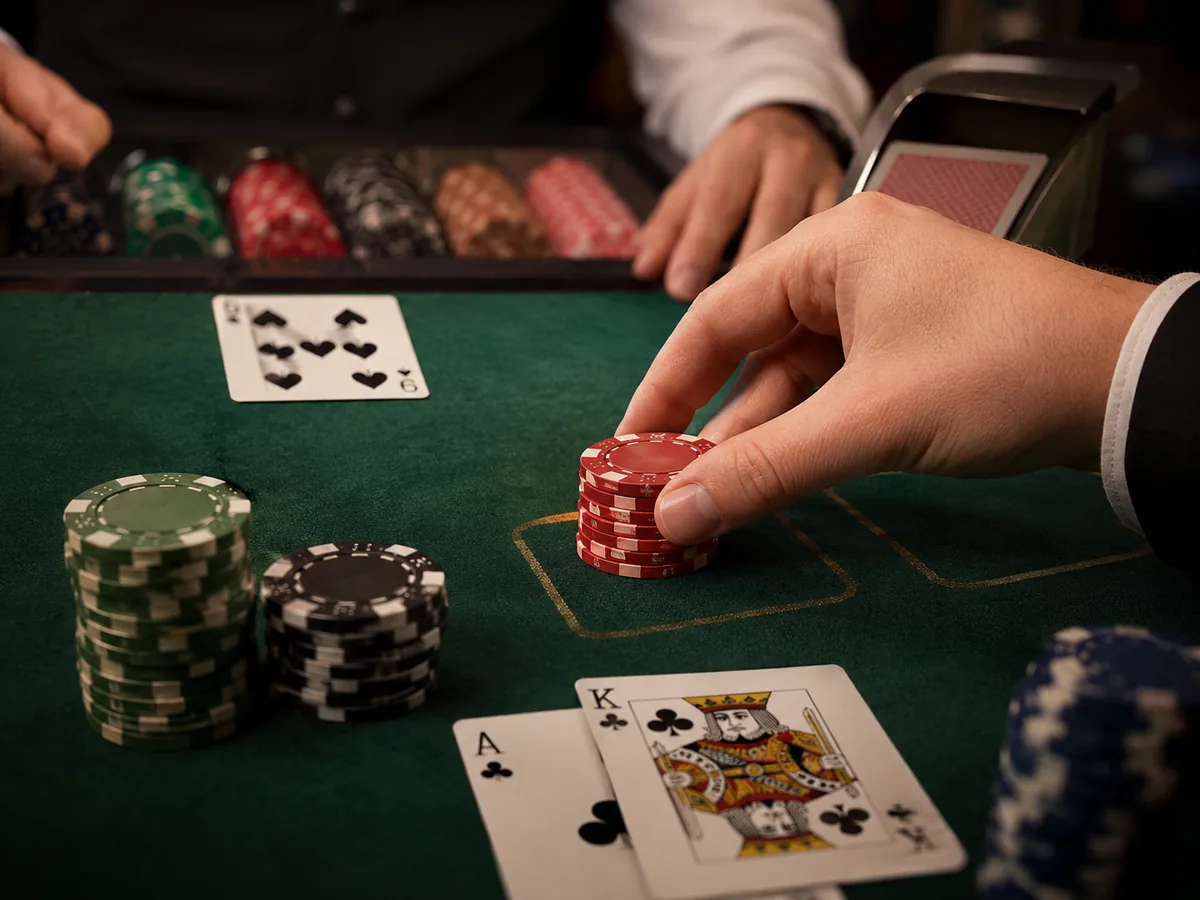
Single-deck games are typically dealt by hand from the dealer's palm rather than from a mechanical shoe, a format often called a "pitch" game. Cards are usually dealt face down to the players (in contrast to most shoe games, where cards are dealt face up and players aren't meant to touch them), and players are permitted to pick their cards up to look at them, which is part of the traditional charm of the format for many recreational players. This hands-on element, combined with the generally lower table minimums historically associated with single-deck games in some markets (though this has shifted over time as single-deck games have become less common and sometimes carry premium minimums instead), gives single-deck blackjack a different feel at the table independent of the underlying statistics.
Pitch-game feel: The source notes that single-deck blackjack is commonly hand-dealt, often face down to players, with more frequent reshuffles and a different table rhythm than shoe or CSM play.
Because the deck is reshuffled far more frequently in a hand-dealt pitch game - often after just one or two rounds, since there simply isn't much of a deck to deal through - the pace of play tends to be slower than a shoe game, with more visible downtime for the shuffle. This is one further practical trade-off worth weighing against the deck-count math: you may see fewer total hands per hour at a single-deck table than at an equivalent shoe or CSM game, which affects your total exposure to whatever house edge is in play over a given session length.
Double Deck as a Middle Ground
| Format | Deck-count position | Typical trade-off described in the source |
|---|---|---|
| Single deck | Largest deck-count benefit of the three. | Often paired with the most aggressive restrictions or 6:5 payouts. |
| Double deck | Middle ground. | Retains some deck-count benefit and may be paired with a less aggressively restricted package. |
| Large shoe | Smaller deck-count benefit. | Can still be the better overall game when it offers 3:2 and stronger surrounding rules. |
It's worth briefly mentioning double-deck ("two-deck" or "pitch") games as a related format that splits the difference between single-deck and larger shoe games. Double-deck games retain some of the deck-count advantage of single deck - a smaller benefit than full single deck, but still a real one compared to four-, six-, or eight-deck shoes - while often being paired with a somewhat less aggressively restricted rule package than many single-deck tables carry, since the smaller inherent player advantage from deck count alone gives casinos less incentive to claw back value elsewhere. Double-deck games are worth the same rule-by-rule scrutiny as any other format, but they're a reasonable option to consider if a casino's single-deck tables all carry unfavorable payout ratios or restrictions.
Practical Takeaways
Single deck blackjack genuinely does carry a real, quantifiable mathematical advantage over shoe games when the rest of the rule package is held constant - but that final clause is the entire point of this article. In practice, casinos very often adjust other rules specifically at single-deck tables to offset that advantage, most commonly and most damagingly through a 6:5 blackjack payout instead of 3:2. The single most important habit for evaluating any single-deck table is to check the payout ratio first and foremost, then work through the rest of the standard rule checklist before assuming that "single deck" by itself is a signal of a good game. When you do find a single-deck table with a genuinely strong overall rule package, it's likely to be one of the better games available anywhere in the casino - but that combination is worth verifying, never assuming.