Blackjack Switch: Rules, Switching Strategy, Push 22 and How to Play
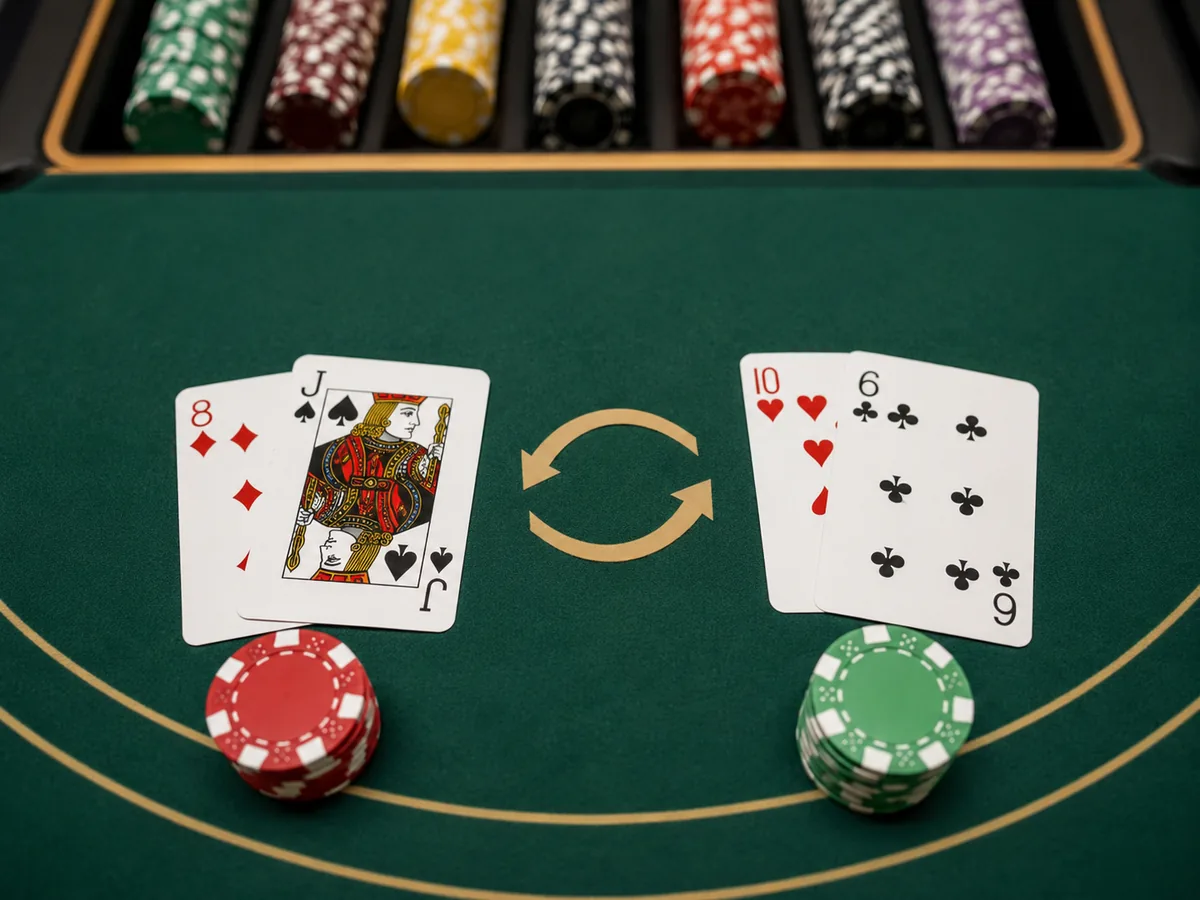
Blackjack Switch is a two-hand blackjack variation built around one unusual decision: after two hands are dealt, you may exchange the second card of one hand with the second card of the other. A poor pair of starting hands can sometimes become two strong hands with a single switch. The trade-off is that winning blackjacks normally pay only even money and a dealer total of 22 pushes against most non-busted player hands. Those rules make Blackjack Switch a strategy game of its own rather than standard blackjack with an extra feature.
Swap the second card dealt to each of your two hands.
You begin with two equal wagers and play two separate hands.
Usually pushes against any non-busted player hand except a qualifying blackjack.
Winning natural blackjacks commonly pay 1:1.
What Is Blackjack Switch?
Blackjack Switch begins with two equal wagers and two two-card hands. Before normal play, you may exchange the second card of the first hand with the second card of the second hand. The first card of each hand never moves.
The switch can turn weak totals into strong ones, but it does not guarantee a win. Because the exchange is valuable, the game balances it with even-money blackjack and the dealer-22 push rule.
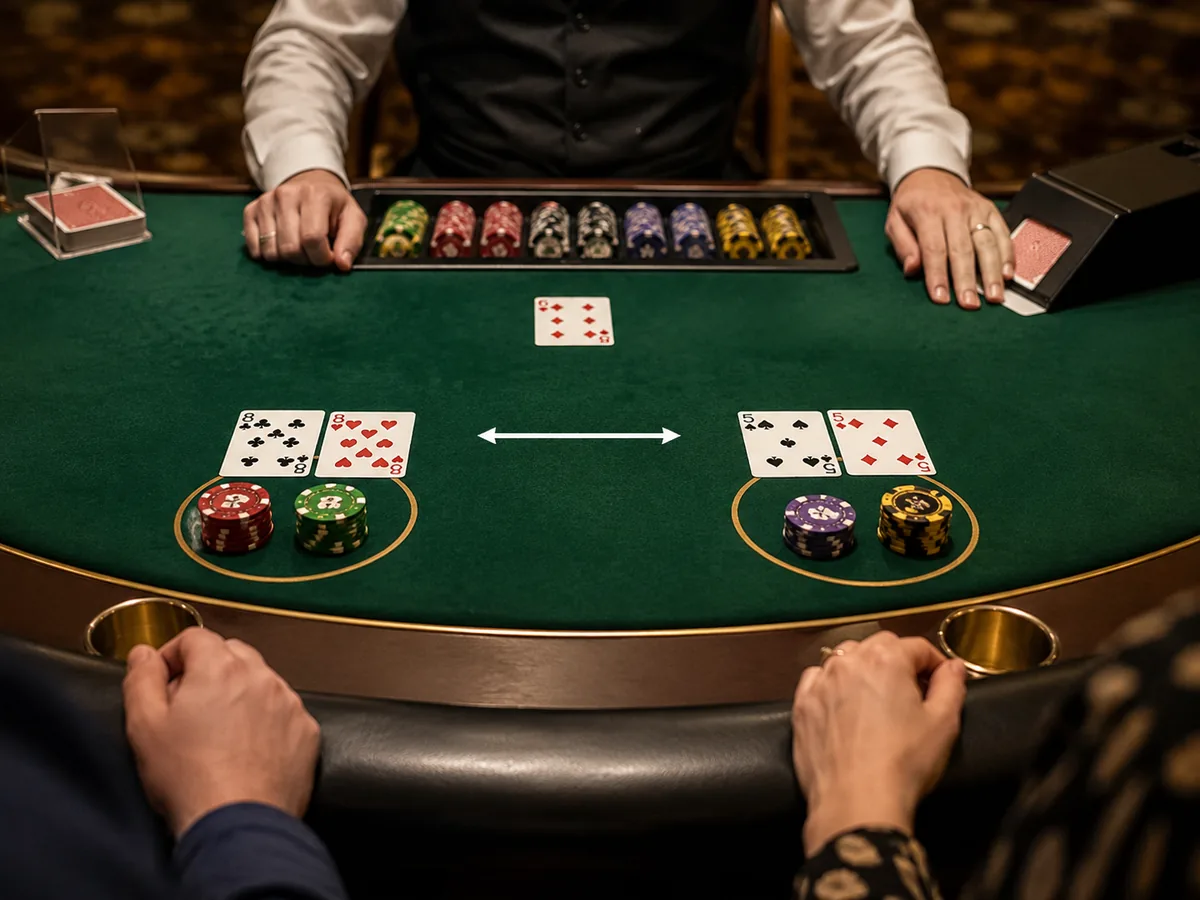
Blackjack Switch Rules at a Glance
| Rule | Common Las Vegas-style Blackjack Switch version |
|---|---|
| Decks | Usually six or eight standard 52-card decks. |
| Starting wagers | Two equal bets are required, one for each hand. |
| The switch | The second card of each hand may be exchanged before normal playing decisions. |
| Dealer soft 17 | Dealer commonly hits soft 17, although some jurisdictions use stand on soft 17. |
| Blackjack payout | Winning natural blackjacks commonly pay even money (1:1). |
| Switched blackjack | Usually treated as an ordinary 21 rather than a natural blackjack. |
| Dealer 22 | Pushes against non-busted player totals of 21 or less; a qualifying natural blackjack can still win. |
| Doubling | Usually allowed on any first two cards. |
| Double after split | Normally allowed. |
| Resplitting | Commonly allowed up to four hands. |
| Insurance | May be offered when the dealer shows an ace. |
Always confirm the posted rules. Stand-on-soft-17 is more favorable than hit-soft-17, switched-blackjack treatment can change the return, and eight decks are slightly less favorable than six.
How to Play Blackjack Switch
- Place two equal bets. Blackjack Switch begins with two separate wagers of the same amount.
- Receive two hands. Each player hand gets two face-up cards. The dealer receives cards according to the table procedure.
- Evaluate the switch. Compare the two hands and decide whether exchanging their second cards creates a stronger overall position.
- Lock the switch decision. Once you switch or decline to switch, the two hands become independent blackjack hands.
- Play each hand. Hit, stand, split or double according to Blackjack Switch basic strategy, which differs from ordinary blackjack because dealer 22 can push.
- Dealer completes the hand. The dealer follows the posted soft-17 rule and the two player wagers are settled separately.
Blackjack Switch Strategy: When Should You Switch?
Perfect switching strategy is more complicated than normal basic strategy because four cards can be arranged two ways and both arrangements must be evaluated against the dealer upcard. A practical simplified method gets close to optimal play.
A commonly published simple method ranks desirable hands roughly as 21, 20, 19, A-A, 11, 10, 9, then 18 or 8. Against dealer 7 or 8, balancing both hands becomes more important; against most other upcards, maximizing the stronger hand is often best.
| Target hand | Why it matters after the switch |
|---|---|
| 21 | Best ordinary total and extremely strong even when created by switching. |
| 20 | Very difficult for the dealer to beat without reaching 21. |
| 19 | Strong made hand that usually needs no further action. |
| A-A | A valuable pair because splitting aces can create two strong starting hands. |
| 11 | Excellent doubling total against many dealer upcards. |
| 10 or 9 | Useful doubling totals when the dealer is weak. |
| 18 / 8 | 18 is a respectable made total; 8 can have useful doubling or hitting potential. |
Judge the two hands together. Improving one hand is worthwhile only if the combined expectation of both wagers also improves.
Playing Strategy After the Switch
After the switch, normal blackjack decisions return, but dealer 22 is stronger than in standard blackjack because it pushes rather than busting against most non-busted hands. That changes some hit, stand and double decisions.
- ✓Use a Blackjack Switch chart. A conventional blackjack chart does not account for the dealer-22 push.
- ✓Separate switching from playing strategy. First choose the best arrangement of the four cards, then use the correct action chart for each final hand.
- ✓Value strong doubles. Creating an 11 or 10 through the switch can be powerful against weak dealer cards.
- ✓Do not overvalue switched 21. At many tables, a 21 created by switching is not treated as a natural blackjack.
- ✓Check soft-17 rules. Stand-on-soft-17 conditions improve the game for the player and alter strategy in some close situations.
Blackjack Switch House Edge and RTP
Under a common six-deck Las Vegas rule set with dealer hitting soft 17, switched blackjack counted as 21, double after split allowed and dealer 22 pushing, optimal strategy produces a house edge of about 0.58%, or a theoretical return near 99.42%.
Eight decks add only a small amount to the house edge. Stand-on-soft-17 improves the game for the player, while stronger treatment of switched blackjack can improve it further. Switching mistakes can cost more than the theoretical edge itself.
Super Match Side Bet
Many tables offer a Super Match side bet based on the player’s first four cards before switching. A representative paytable rewards one pair, three of a kind, two pair and four of a kind.
| Initial four-card result | Representative payout |
|---|---|
| One pair | 1:1 |
| Three of a kind | 5:1 |
| Two pair | 8:1 |
| Four of a kind | 40:1 |
Under this common paytable, the Super Match house edge is about 2.55%, much higher than the main game when Blackjack Switch is played well.
Blackjack Switch vs. Standard Blackjack
| Feature | Blackjack Switch | Typical standard blackjack |
|---|---|---|
| Player hands | Two hands with equal bets | Usually one hand per betting spot |
| Card exchange | Second cards may be switched | No switching |
| Natural blackjack | Commonly pays 1:1 | Often pays 3:2 |
| Dealer 22 | Usually pushes non-busted hands | Normally a dealer bust |
| Switched 21 | Usually treated as ordinary 21 | Not applicable |
| Double after split | Commonly allowed | Depends on table rules |
| Strategy challenge | Switch decision plus adjusted blackjack strategy | Basic strategy only |
Why Dealer 22 Pushes
The ability to rearrange four cards is valuable, so dealer 22 pushing is a key balancing rule. Instead of losing automatically when the dealer reaches 22, most non-busted player hands simply push.
Because dealer 22 has fewer losing outcomes, Blackjack Switch basic strategy differs from ordinary blackjack. A natural blackjack is usually protected, but check how the table treats a 21 created by switching.
Blackjack Switch FAQ
Which cards can be switched in Blackjack Switch?
Only the second card dealt to each of the two player hands can normally be exchanged. The first card in each hand stays in place.
Do you have to switch the cards?
No. Switching is optional. If the original arrangement is stronger, keep the hands as dealt.
What happens if the dealer makes 22?
Under the common rules, dealer 22 pushes against any non-busted player total of 21 or less. A qualifying natural blackjack can still beat dealer 22.
Does Blackjack Switch pay 3:2 for blackjack?
Usually no. Winning natural blackjacks commonly pay even money, or 1:1.
What is the house edge in Blackjack Switch?
Under a standard six-deck Las Vegas-style rule set, optimal play produces a house edge of about 0.58%. Different rules can raise or lower that figure.
Final Takeaway
Blackjack Switch adds a unique decision: rearranging the second card of two hands before playing them. Evaluate both wagers together, make the best switch, then use strategy adjusted for Push 22. Check deck count, soft-17 rules and switched-21 treatment. For related games, compare Spanish 21, Double Attack Blackjack and Pontoon.